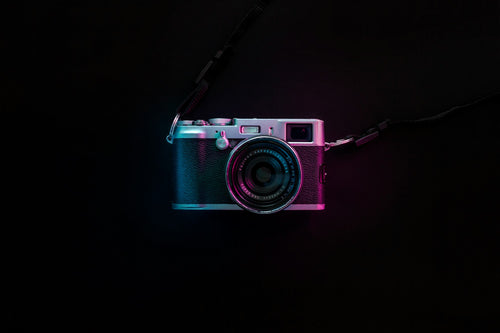
TEST IMAGE. Instant camera.

Polaroid SX-70

€395,00
Skip to product information
TEST IMAGE. Instant camera.

CamerasInstant cameraNo. T-015

1974now

Polaroid SX-70

From the collection of Mira, Utrecht

▶  Hear Mira tell it, 9 min

TEST DATA. A 1974 Polaroid SX-70, folding, leather and chrome.

€395

About this one
TEST DATA. A 1974 Polaroid SX-70, the original folding model in chrome and tan leather. It collapses flat to about an inch and opens into a single lens reflex.
TEST DATA. Instant pictures, one at a time, at a pace that makes you think first. Film is still made for it, though it is not cheap and it is not the original chemistry. The battery is in the film pack, not the camera. No film means no power, which is why it seems dead when it is not.
TEST DATA. Most SX-70s for sale have perished leather or a torn bellows, and a torn bellows is the end of the camera. This one has neither. The leather is original and still supple, and the bellows was checked in a dark room with a torch inside it.
Condition

How it looks

TEST DATA. Chrome bright with light marks on the top edge. Leather complete, no lifting at the corners. A small scuff on the base.

How it works

TEST DATA. Tested with a fresh pack. Motor runs, rollers turn, picture ejects and develops. Focus is smooth through the whole range. Bellows light-tight, checked in the dark with a torch inside. The exposure wheel works. Whether it is accurate is a judgement — set it a third toward dark to start.

Checked by Unseend in August 2026, before it was photographed and again before it is packed. Every photograph on this page is of this exact piece.

The facts
Year1974
Made byPolaroid
Made inUS
Weight700 g
ObjectNo. T-015
In the box
TEST DATA. Camera only. No film, no case.

Kept 1974–2026 · 31 objects

Everything Mira passed on

Where it came from

Mira, Utrecht

Mira's cameras

TEST DATA. Thirty-one cameras and two watches, kept in one cabinet in the hallway for fifty years. Mira bought the first one to photograph her children and never stopped.
I kept them where I walked past them. A camera you cannot see is a camera you never use.
In Mira’s own wordsOpens here

TEST DATA. The cabinet was in the hallway, which everybody found strange. Most people keep a collection somewhere out of the way, in a spare room or a cellar, and mine was the first thing you saw when you came through the door. That was deliberate. I wanted to walk past it.

The first one was a Zeiss my father gave me in 1974, the year my eldest was born. He said a photograph is the only thing you can make that is worth more in thirty years than it was on the day, and he was right about that, although he was wrong about almost everything else. I still have the light meter that came with it. That one is not for sale.

I bought the second because the first jammed, and the third because the second was too heavy to carry with a child on my hip. After that there was no reason any more. There was a market on Saturdays where a man sold cameras out of a suitcase, and I went every week for eleven years. He knew what I had and he would keep things back for me. When he died his daughter sent me a box with four of them in it and a note that said he had put them aside.

People ask whether I used them. All of them. Every single one has been through a roll. There are cameras in that cabinet that have photographed three of my children and two of my grandchildren, and a few that only ever went to Zeeland and back, and one that I took to Rome and dropped on the steps at Santa Maria in Trastevere. That one still works. You can see the dent.

What I was never interested in was the boxes. I know that is what makes them worth something, and I know I have cost myself money over fifty years by throwing them away, but a camera in a box is a paperweight. I bought them to use and I used them, and the marks on them are mine.

The hardest part was not deciding to sell. It was deciding not to leave them to the children. They do not want them, and they were too polite to say so for about ten years, and in the end my daughter said it plainly, which I am grateful for. A collection that nobody wants becomes a burden the day after you die.

So I would rather hand them over now and know. That is the whole reason I said yes to this instead of the auction house, who wanted them in lots of eight with no names on anything. I want the person who buys the Rolleiflex to know it went to Rome.

More like this